Hesiod
Hesiod is the second after Homer well known Hellene poet. Modern historians have agreed that he was born close to 850 b.C. but ancients believed he was born at 2300 b.C.
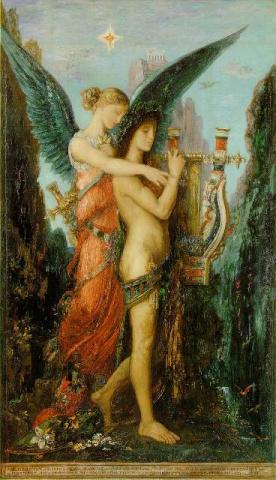
His father cafe from Kyme of Aeolis and he was a sailor. But his job didn't provided a lot of money to live, so he want to Beotia and he lived in Askra, close to Ellicon. He changed profession, raising sheeps. He had two sons. Hesiod was a shepperd until one day the Muses found him in Ellicon and talked to him giving also a wand of bay and the ability to make great poems. After that incident he participated in poetic games in Chalkida of Euvoia and he won a tripod with two handles.
In his work Theogonia, Hesiod describes the most sacred written subject, the born of all Gods and the creation of the world. His poem consists of 1022 verses. It is full of mythological information, but notice that all those are not just one tradition, but he collected older books and oral traditions and he composed them or published older books as one book with all the information about Gods. So, he may have written Theogonia in 850 b.C. but the knowledge came from earlier years.
If we read his works, we can notice that Hesiod writes a big section about Hekate. Thus means that Hekate was famous before 850 b.C. in Hellas. Moreover, Hesiod's brother and Hekate's father had the same name, Perses. Maybe his father had close relations with Hekate and Hesiod too.
The part of Hekate
Asteria of happy name, whom Perses once led to his great house to be called his dear wife. And she conceived and bare Hekate whom Zeus the son of Kronos honoured above all. He gave her splendid gifts, to have a share of the earth and the unfruitful sea. She received honour also in starry heaven, and is honoured exceedingly by the deathless gods. For to this day, whenever any one of men on earth offers rich sacrifices and prays for favour according to custom, he calls upon Hekate. Great honour comes full easily to him whose prayers the goddess receives favourably, and she bestows wealth upon him; for the power surely is with her. For as many as were born of Gaia and Ouranos amongst all these she has her due portion. The son of Kronos did her no wrong nor took anything away of all that was her portion among the former Titan gods: but she holds, as the division was at the first from the beginning, privilege both in earth, and in heaven, and in sea. Also, because she is an only child, the goddess receives not less honour, but much more still, for Zeus honours her.
Whom she will she greatly aids and advances: she sits by worshipful kings in judgement, and in the assembly whom she will is distinguished among the people. And when men arm themselves for the battle that destroys men, then the goddess is at hand to give victory and grant glory readily to whom she will. Good is she also when men contend at the games, for there too the goddess is with them and profits them: and he who by might and strength gets the victory wins the rich prize easily with joy, and brings glory to his parents.And she is good to stand by horsemen, whom she will: and to those whose business is in the grey discomfortable sea, and who pray to Hekate and the loud-crashing Earth-Shaker, easily the glorious goddess gives great catch, and easily she takes it away as soon as seen, if so she will. She is good in the byre with Hermes to increase the stock. The droves of kine and wide herds of goats and flocks of fleecy sheep, if she will, she increases from a few, or makes many to be less. So, then. albeit her mother's only child, she is honoured amongst all the deathless gods. And the son of Kronos made her a nurse of the young who after that day saw with their eyes the light of all-seeing Eos. So from the beginning she is a nurse of the young, and these are her honours.
Image : Hesiod and the Muse (1891), by Gustave Moreau





It amazes me how so many traditions follow these ancient protocols and roles,